Posts

“Faith After the Fire: Reimagining God When the Church Failed You”

Image
  There’s no easy way to talk about the space between queerness and faith—especially when it feels like standing in a burning building while everyone else calls it a sanctuary. For many of us who grew up Black, queer, and deeply devoted to God, the church wasn’t just a building. It was a lifeline. Until it wasn’t. This post isn’t about pointing fingers or demanding pity. It’s about making space for truth, for grief, and for the complicated holy tension between love and loss—between leaving what harmed you and still longing for what it promised. Fitting In Systems Never Built for Me When I was younger, I learned how to shape-shift. To pray the right prayers, sing the right songs, sit with my knees closed and voice small. I was praised for my "maturity," but really, I was surviving. Every part of me that didn’t fit the church’s mold—my gender, my desires, my neurodivergence—was folded, hidden, and locked away. The pain didn’t come from not loving God. It came from being told I ...

Grants, Fellowships, and Residencies for Trans and Neurodivergent Writers

Image
  Follow my blog with Bloglovin Because our stories are worthy—and so are our needs. The Truth: Opportunities Exist, But They Don’t Always Knock Let’s name it plain: writing takes time, energy, and resources—and if you’re trans, disabled, Black, neurodivergent, or low-income, getting access to those resources can feel like searching for a door that was never built for you. But that doesn’t mean we don’t belong here. It means we have to find our way in through the cracks—and sometimes, build our own rooms in the process. Grants and residencies can be a lifeline . They offer more than just money. They offer space. Time. Structure. Sometimes housing. Sometimes community. And more and more, these programs are actively looking for writers who live at intersections—whose stories don’t fit the mold, and never should have had to. But here's the key: you have to know where to look. 📹 Want a visual primer? This YouTube video by The Write Practice explains what writing residenci...

Free & Low-Cost Writing Tools for Marginalized Writers

Image
  Because expression is a right, not a luxury. Writing Past the Gatekeepers Let’s be real: writing is powerful. But in this industry, access often comes at a cost. The best tools—those praised in writer circles, marketed as “essential,” or required by editors—tend to be behind paywalls. And for many of us—especially trans writers, disabled creatives, Black and Brown storytellers, and anyone trying to make art while navigating poverty or chronic survival—those costs add up fast. But here’s the truth: You don’t need fancy software to write brilliant stories. What you need is a way to begin —a place where your voice can land, stretch, breathe. The good news? Those spaces exist , and many of them are free or low-cost. They may not have every bell and whistle, but they’ll support your creativity without asking you to sacrifice rent or groceries for the sake of a monthly subscription. Here’s a breakdown of some of the best accessible writing tools out there—tools I’ve used, tested, an...

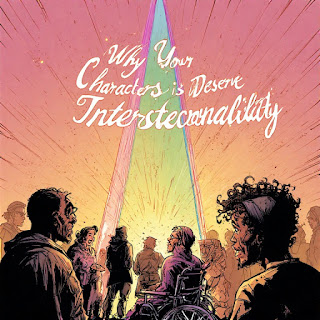
Why Your Characters Deserve Intersectionality: Going Beyond Representation

Image
  Because we’re more than one thing. And so are our stories. We’ve come a long way when it comes to representation in media, but visibility alone isn’t justice. A single queer character, a disabled sidekick, or a BIPOC love interest might tick the “diversity box,” but that doesn’t mean the work is done. It doesn’t even mean it’s started. True inclusion isn’t about optics. It’s about reflecting the complex, interwoven realities people live every day. That’s where intersectionality steps in—not as a buzzword, but as a framework for writing characters who breathe.  1. What Is Intersectionality, Really? The term intersectionality was coined by legal scholar Kimberlé Crenshaw in 1989 to describe how systems of oppression—like racism, sexism, ableism, and transphobia—overlap and intensify each other. She used the term to highlight how Black women face unique struggles that can’t be fully understood by looking at race or gender alone. In storytelling, this matters more than m...

Writing Through a Psychotic Episode: What I’ve Learned About Voice and Reality

Image
A craft reflection from the margins of the mind. When I was in the middle of a psychotic episode at Job Corps in Williston, ND, writing didn’t feel like therapy. It felt like survival. The lines between fiction and hallucination blurred, but somewhere in that space—between fear and clarity—I found a new voice. And I realized something: madness and creativity are not enemies . They're tangled. And sometimes, writing is the only thread that holds. This isn’t a guide for writing about psychosis from the outside. It’s a glimpse into what it’s like to write through it —as someone who’s lived it. 1. Reality Is Fluid—And That’s Not a Flaw When you’re experiencing psychosis, what’s “real” becomes negotiable. Sounds take on meaning. Objects breathe. Time folds. But when I put pen to paper, I stopped trying to explain the episode and started exploring it. 🔸 Writing became a way to honor the experience without romanticizing the pain . In craft terms, this unlocked something essentia...

Creating Trans Characters Without Tokenism: A Craft Guide

Image
Because we deserve more than a subplot and a stereotype. I’ve lost count of how many times I’ve read a book where a trans character is introduced only to either educate the protagonist, disappear after two scenes, or become a walking trauma dump. These portrayals aren’t just disappointing—they’re damaging. Trans readers deserve characters who are real , nuanced , and not written solely for cis readers to learn something . This post is for cis writers who want to do better, and for trans writers who are reclaiming space on the page. Let’s break this down. 1. Don’t Make Them the Lesson Trans characters are too often written like moral props—a checkpoint in the protagonist’s growth. The cis main character learns to “accept them,” and then the trans person fades out. This approach centers cis feelings and completely sidelines the actual personhood of the trans character. 🔸 Instead : Make your trans character's arc their own. Do they want to open a bakery, survive senior year, or re...

Neurodivergent Approaches to Plot Structure: Letting Go of ‘The Rules

Image
  If you’ve ever stared at the three-act structure and thought, this doesn’t fit the story in my head, you’re not alone. Many neurodivergent writers—myself included—find that traditional plot structures can feel restrictive or even discouraging. This post is for the writers who have been told their storytelling is “too weird,” “too scattered,” or “not structured enough.” If that rings a bell, maybe it’s time to explore narrative forms that fit you , not the other way around. 1. Recognizing that Structure is a Tool, Not a Law Much like grammar, plot structure exists to serve your story—not to limit it. The three-act structure, Hero’s Journey, Save the Cat—these are useful tools, but they were designed within a neurotypical framework. If your brain doesn’t move in a straight line, why should your story? The three acts is, inciting incident, midpoint, climax, resolution. While these blueprints can be helpful, they’re just one lens. They’re not a universal truth. Neurodiverge...